Forest degradation, biomass damage and global warming: a call for a change in human behaviour
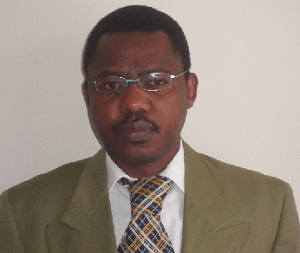
Africa & Science: You have just published an article of great interest to the scientific community. After reading that article, it appears that your research has been conducted in a rainforest in Cameroon, Central Africa. Why did you choose this site? Why did you not choose a Canadian forest that would have been geographically more accessible because of your residency in Canada?
Adrien Djomo: Let me begin by thanking you and Africa & Sciences for inviting me to comment this scientific article of great interest that I am sure will contribute to better understand how we can influence human behavior to change our negative impact on the environment. As you may know, Central Africa represents the second largest tropical forest in the world after Amazonia. Of course, I live in Canada, but I was born in Cameroon and it was easy to me to have contact which allows me to carry numerous data that have helped for this publication. Now that I am living in Canada, the contact I built here will also help me to get access to data and resources which may help to give other contributions.
You know deforestation and forest degradation after burning of fossil fuel represent the most important source of emissions of greenhouse gases. Thus, undertaking research that aims providing tools for changing human behavior in the sense of minimizing the impact is a positive contribution.
Deforestation and forest degradation was presented during the recent discussion on global warming as problems of developing and tropical countries. Indeed, the rate of deforestation and forest degradation is higher in the southern countries today, but still it also occurs in many industrial and northern countries where clear cutting and logging are parts of their management systems. Of course it was a way of balancing the problem of burning of fossil and industrialization processes in northern countries which have created serious impact on environment and make southern countries been also responsible at certain extend. Therefore the term REDD has evolved over time. The term has evolved from Reducing Emissions from Deforestation in Developing Countries to Reducing Emissions from Deforestation and Forest Degradation. This is because deforestation and Forest degradation are present in all latitudes. For example, in a country like Canada where I live, clear cutting and logging continue to have harmful effects on ecosystems and on global warming. The explanation given above proves that even if the data were collected from a tropical country, taking into consideration the forest management approaches, the findings of this research can be applicable in all latitudes regardless the area.
A & S.: Funding is always a key issue in a research project. Was it easy to find financial support for your research?
A. Dj: Yes of course, finance and technical support have always been an issue for research and development. That is why I use this opportunity to thank all the institutions which have contributed directly or indirectly for this research. I think of WWF, GTZ, the University of Goettingen, KAAD, the University of Toronto and the University of Saskatchewan.
A & S.: With less technical words what is the main result or conclusion of your research?
A. Dj.: The main conclusion is that the way human beings do the logging can minimize seriously the impact on the environment. It is important to determine properly the minimum harvested diameter by taking into account the capacity of reconstitution of each species targeted and by adopting logging practices that have less damage on other trees, soil, water and support growth of natural regeneration. Applying this techniques can help save up to 35 MgC ha-1.This study also provides to forest practitioners a silvilcultural system scenario for monitoring forest management under REDD.
A. & Sc.: Your publication will most likely be read by many researchers in your field. Do you have the certainty that your views will be shared by the large majority of specialists?
A. Dj.: The aim of scientific research is to test hypothesis with measurable data and to provide foundation for innovation, future research or future development. In this respect, each research is a contribution and I hope that many researchers and forest practitioners will read this publication and found information which will enhance discussion in this topic and also help to adopt positive logging practices in all latitudes. You know, we are living at a so critical time of our history and the threat that the earth is facing through humankind actions is so huge that we need to multiply efforts to look for the best way to induce less impact actions at all levels; it is the only way to meet the target of reduction. I hope therefore that this research will go beyond his findings and help all stakeholders to engage in activities which represent the best practices that may contribute to save our planet. I hope also that politicians will follow with courageous decisions which change the business as usual for a kind of business which cares most for the present and the future interest of the people.
A. & Sc.: It is not possible to talk about global warming today without mentioning the Kyoto protocol agreements. This agreement clearly requires a change in the industries processing, transportation and human behaviors in northern countries as a major solution to the problem. Today, it seems unlikely that the industrialized countries including the USA and Canada comply with the requirements of Kyoto protocol. The Canadian government has even withdrawn from this protocol. Are you still optimistic?
A. Dj.: I know since the last earth summits (Copenhagen, Durban in South Africa), people were disappointed around the world by our top leaders and politicians who have not been able to lead the world into the direction that the large community of voiceless was waiting. But this seems not to discourage folks because everyone knows today that it is part of our live, it is part of our future. Have you seen the mobilization that was reached this year during the earth day? This mobilization showed once more that people are waiting change in the world. We need therefore good leaders across the earth who will know how to impulse the world in the direction where individuals, businesses, all kinds of politicians will change present threatening actions and make our children proud of us and say that “their father and grandfather lived at a critical time of their history, but they did their own share to make sure that the future was not compromised”. I use this opportunity to say that I am disappointed by the National Conventions of both republican and democratic parties in the USA which are facing presidential elections. Of course, the main topic is how to make the political orientation to change the actual economical situation and give a better live to people. None of the political parties and mostly republicans has incorporated in their main talks the fact that the poor economical situation that the USA is facing today is due to a wrong environmental orientation. Without a change of the business as usual, it is impossible to make a serious change in our future economy. This is true for the USA and also for other countries in the world. When Barack Obama mentioned during his acceptance speech how he will make orientation to more efficient technology using less energy, how he will invest on renewable energy and make USA less dependent on oil, coil and other forms of non renewable energy, the crowd was so enthusiastic. But does it show that American leaders including Barack Obama are ready to discuss a target emission cut, which is the main issue that is the main question.
A. & Sc.: Your critics raise a practical question: How can your research support or be the base for the development of innovative strategies in the sector of “green logging” industry?
A. Dj.: This article focuses on the stewardship of green logging. Green logging requires a planning which will help to decide on which trees you need to remove from the forest without triggering the biodiversity. This article discusses a harvest event analysis and shows the baseline for the sustainability of the selected species. Clear cutting has proven in large extend negative impact on biodiversity, on environment and on the long term economy. Green logging requires also thinking on natural or manmade regeneration. This research has also analyzed the regeneration capacity under logging and shows that the loss of genetic materials is possible if we don’t take into consideration the reconstitution capacity of target species. Monitoring the impact of logging has to be a good practice for green logging and this research show clearly that the intensity of logging if it is too high would be able to have negative impact on biodiversity; it is important to define logging intensity prior to the selection and its impact on the remaining ecosystem. For more information on this research I recommend to read this scientific article at the following link: http://www.davidpublishing.com/journals_show_abstract.html?7214-0 . You can also contact me directly.
A. & Sc.: Thank you for your explanations.
This interview was realised on September 4th, 2012. For details about the research agenda of Dr. Adrien DJOMO, please refer to his website: http://www.adriendjomo.com/
Livre: Les déchets informatiques: Quel devenir pour l’Afrique ? Par Serge Edene Kenya, Cameroun, Côte d’Ivoire, Congo-Kinshasa, etc. Au nom de l’éthnie, on tue !
Comments are currently closed.