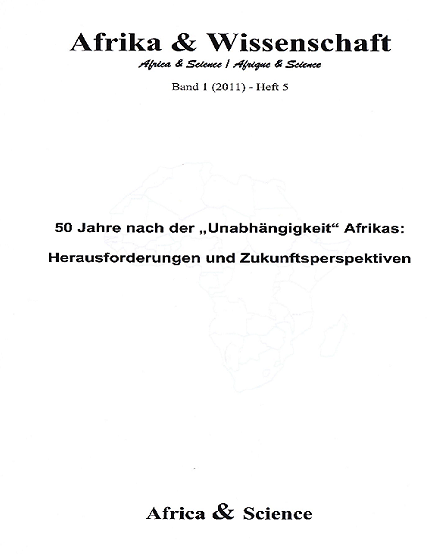
The New issue of our Scientific Journal: Africa & Science / Afrika & Wissenschaft- Band 1, Heft 5 (2011)
 Knowledge and Science in Contemporary Africa
By Joseph C. A. AGBAKOBA (Prof. Dr.)
Professor of Philosophy, University of Nigeria- Visiting Scholar at the University of Frankfurt am Main (Germany)
Abstract:
Knowledge production, conservation and transmission are fundamental to the development of any human community. To make it possible, cooperation between all social segments is a prerequisite. This paper sets out to discuss the state of knowledge in postcolonial Africa. Taking Nigeria as case study, it highlights the confinement of knowledge within (conflicting) segments of the society, the lack of cooperation and poor knowledge circulation between the traditional and the modern sectors; a situation which hinders any progress in the area of science and technology.
**********
Political Actors or Instrument of Politics: African Youths, Nationalism and the Post-colonial Politics of Alienation-A Nigerian Case Study
By Darlington C. Ashamole (MA)
PhD Candidate, Depart. of Politics and International Relations, University of Frankfurt (Germany) & The Univ. of Sheffield (UK)
Abstract:
Since the political independence of the African states no issue has been so controversial and contentious like political power and access to political space. The political elite, who (as young men) fought for Africa’s independence, have (after gaining that political freedom) refused to step aside from political stage. Instead, they chose to personalize politics and treat power as birth right. This form of politics has consequently created scenarios where subsequent generations of African youth are alienated from political power by those groups of elite who see politics as business of the older folk. Noticeably, in almost all African states (Nigeria, Cameroon, Senegal, Algeria, Zimbabwe, Kenya, etc) it is still the same set of elites and their cliques that have dominated political power and space since independence. This marginalization of youths in the postcolonial African politics forms the background of this paper. Taking Nigeria as a case study the paper analyses the role and place of youths in the African postcolonial politics, particularly the reasons behind their marginalization by the older generation in the political arena. Beside demonstrating that youths were political actors prior to independence or during African nationalist struggle, the paper also argues that corruption, commercialization of politics, unemployment and lack of education are responsible for the phenomenon (political alienation of youths). It also contests that the present generation of African youths are partly responsible for their plight and the political injustice they are subjected to by the elders, in that majority of them are politically and morally disoriented. And this has led to a situation where they became political instrument rather than political actors.
**********
Secular Missionaries and Epistemic Power
By UCHENNA OKEJA (Dr. phil)
Postdoctoral fellow, Department of Philosophy and Lecturer in Business Ethics, Department of Business Administration, University of Frankfurt am Main (Germany)
Abstract:
With the publication of Dambisa Moyo’s book titled Dead Aid in 2009, an increased discussion of aid to developing countries from different angles ensued. Most of the discussions have focused on the economic and moral sides of the aid industry. In this paper, I discuss a neglected but vital aspect of the practice of aid, namely, the epistemic dimension. Thus, I ask: what is the connection between aid giving, taking and the power of knowledge? How does the relationship of these concepts play itself out in relation to epistemic (in)justice and what are their impacts on both the givers and receivers of aid? To address these questions, this paper focuses on 1) a characterization of the process of secular missionarism with a view to 2) establishing the epistemic (in)justice involved in the patterns of relations engendered. This leads to the central argument that 3) there is a fundamental epistemic imbalance in the practice of aid namely, epistemic disenfranchisement. To dislodge the misdeeds of this imbalance, the suggestion here is that there is the need for a real dialogue situation where neither of the parties will be credited or debited with propositions that ultimately cripple their epistemic agency overtime.
**********
Controversial origin of mathematics
By Etienne NANA CHIADJEU (Dr. rer. nat)
Wissenschaftlicher Mitarbeiter, Fachbereich Mathematik–Informatik, Universität Kassel, Deutschland
Abstract:
This article is about the history of mathematics. It is a historical investigation, a search on the discovery of the first signs of mathematics in the history of humanity. This research is guided by the most recent discoveries in the field of archaeology and aim at highlighting points which might have been omitted in Africa’s contribution to the development of Mathematics as science.
**********
Trinkwasserversorgung und Panafrikanismus
Von Chicgoua NOUBACTEP (PD Dr.)
Kultur und Nachhaltige Entwicklung CDD e.V., Göttingen, Deutschland
Zusammenfassung:
Gegenwärtig haben weltweit rund 880 Millionen Menschen keinen Zugang zu sauberem Trinkwasser. Eine nachhaltige Versorgung der Weltbevölkerung mit sauberem Trinkwasser gehört zu den zentralen Herausforderungen der Menschheit. Im Rahmen des Millenniumsentwicklungsziels wollen die Vereinten Nationen bis 2015 diese Zahl auf 600 Millionen reduzieren. Die Fachwelt ist sich heute (August 2011) darüber einig, dass dieses Millenniumsziel in Afrika wohl nicht erreicht werden kann. Um es erreichen zu können, würde man belastbare, innovative und effiziente Wasseraufbereitungstechnologien benötigen, die finanziell tragbar sind. Hat man eine solche Technologie zur Hand, so kann man afrikaweit eine flächendenkende Versorgung mit gutem Trinkwasser erzielen. Da eine solche Technologie nun konzeptuell vorliegt, zeigt dieser Beitrag an, wie man durch eine dezentrale kontinentale Trinkwasserversorgung dem Afrikaner sein angeborenes Selbstbewusstsein zurückgeben kann. Es wird die These vertreten, dass Afrika nur an sich glauben müsste, um die universelle Naturwissenschaft zur Lösung seiner Probleme einzusetzen. Demnach ist Entwicklungshilfe, z.B. in Form von Technologietransfer, nicht unbedingt erforderlich – oder gar überflüssig. Ein Grundgedanke des Panafrikanismuskonzeptes war es, das aufgezwungene Modell des Nationalstaates durch einen lebensfähigen Kontinentalstaat zu ersetzen. Der Panafrikanismus ist ein Mittel zur Wiederherstellung der eigenen, afrikanischen Identität. Die Lösung des lang andauernden Problems der Trinkwasserversorgung aus eigener Kraft ist als ein Eckstein für die Verwirklichung des Panafrikanismus anzusehen.
**********
Migration von Afrika nach Europa 50 Jahre nach der Unabhängigkeit: Ursachenzuschreibung der deutschen und senegalesischen Zeitungen
Von Florence TSAGUE ASSOPGOUM (Dr. phil.)
Politologin, Fachbereich Romanistik, Universität Siegen, Deutschland
Zusammenfassung:
Das Ausmaß der Abwanderung aus vielen afrikanischen Ländern weckt zurzeit zunehmend mediales Interesse. Die Frage, was die Menschen dazu veranlasst, ihre vertraute Heimat zu verlassen, ist von wissenschaftlicher, gesellschaftlicher und medialen Relevanz. Der Prozess der Migration muss gründlich erforscht werden, um eine Steuerung bzw. eine Minderung der Folgen effizient entgegen zu treten. Damit erweist sich die Ursachensuche als eine der wichtigsten Beschäftigungen des Menschen und der öffentlichen Kommunikation. Die Attributionstheorie befasst sich daher mit den gesellschaftlichen Prozessen der Ursachenzuschreibungen. Da das Phänomen Migration als ein gesellschaftlich und politisch relevantes Thema besonders im Zentrum der öffentlichen Kommunikation rückt, setzt sich der vorliegende Artikel mit der Frage nach den Ursachendiskursen und Verantwortlichkeitszuschreibungen von Migration aus Afrika nach Europa auseinander. Er wird gezeigt, dass die Presse in Deutschland dieses Phänomen als eine Folge der Armut deutet, während die in Senegal darüber hinaus kausale Zusammenhänge zwischen Armut, Kolonialismus und Nord-Süd-Beziehung herstellen.
**********
Analyse des theoretisch postulierten Zusammenhangs zwischen den beiden Konzepten am Beispiel von Ahanta West District Assembly und Awutu-Effutu-Senya District Assembly in Ghana
Von Kocra ASSOUA (Prof. Dr.)
Politologe, Entwicklungspolitik und Politik Afrikas, Universität Bayreuth, Deutschland
Abstract:
Die seit den 1990er Jahre zunehmende Popularität des Konzepts Dezentralisierung in Afrika ist auf die Defizite der seit fast zwei Dekaden eingeführten demokratischen Reformen zurückzuführen. Aus dieser Perspektive kann Dezentralisierung als ein Verstärkungs- und Zusatzelement zur Stärkung der Demokratisierung verstanden werden. Im demokratisch theoretischen Diskurs über den Zusammenhang zwischen Dezentralisierung und Demokratisierung wird sehr oft debattiert, welchen Beitrag lokale Demokratie oder Selbstverwaltung zur Konsolidierung von Demokratie leisten. Inwiefern lassen sich diese theoretisch postulierten Zusammenhänge empirisch belegen? Kann Dezentralisierung mit Demokratisierung gleichgesetzt werden bzw. kann ein Staat mit dezentralisierten Strukturen als demokratischer Staat bezeichnet werden? Anders formuliert: Besteht ein Korrelation zwischen Dezentralisierung und erhöhter Partizipation? Unter welchen Voraussetzungen kann Dezentralisierung zu hoher Zivilbeteiligung beitragen? Ausgehend von der Annahme aus, dass falsche Erwartungen bezüglich der Dezentralisierungsreformen zu gravierende Fehlentwicklungen bei der Umsetzung von Entwicklungsprogrammen führen können, scheint es in diesem Beitrag sinnvoll die hoch gelobten postulierten Zusammenhänge zwischen Dezentralisierung und Demokratie auf der einen Seite und Dezentralisierung und Partizipation auf der anderen Seite näher zu erörtern und empirisch zu überprüfen.
To order a copy of the journal, please refer to the following link:
Comments are currently closed.