Water management – water crisis: what can we do to prevent or reduce the crisis!

On March 22, 2013, the international community celebrated the World water Day. To mark this important day, Adrien Djomo and Madelyn Webb (bio-environmentalists) share with readers their analysis on the importance of this precious resource.
Le 22 Mars 2013, la communauté internationale a célébré la Journée Mondiale de l’eau. À l’occasion de cette journée si importante, Adrien Djomo et Madelyn Webb (bio-environnementalistes) ont bien voulu partager avec les lecteurs leur réflexion sur l’importance de cette précieuse ressource.
********************
The abundance of water in Canada and in some countries such as Brazil, Russia, etc. induce most Canadians and some people in the world to take water for granted. They don’t realize that we need a sustainable management of this precious resource to prevent the crisis. Over use of water linked to global warming is now threatening this important resource. This presentation illustrates the water cycle, the situation in Canada, in U.S, in Africa, the importance of the crisis in the world and provides some actions needed to reduce the crisis.
Water management – Water crisis
Water cycle
Water represents 71% of the earth surface and is covered by oceans, seas, lakes, rivers, streams, etc. When the sunlight enters to the earth surface, it heats water and plants creating vaporization of water molecules and transpiration of plants. The water vapour in the atmosphere gets cold and changes back into liquid forming clouds through condensation. After a certain level, more accumulation is not possible and the water falls back onto the earth’s surface through precipitation which can be rain, snow, sleet or hail. Part of the water infiltrates into the ground and remains in the water table and another part runs off to fill the water reservoirs (sea, ocean, lakes, rivers, streams, etc.). The process continues over and over if not disrupted and constitutes the water cycle.

Source: Environment Canada
Situation in Canada
Availability
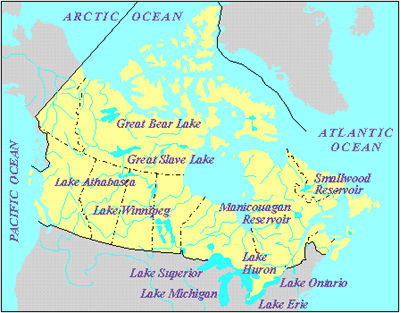
Canada is blessed being surrounded by three oceans (the Atlantic in the east, the Pacific in the west and the Arctic in the North). The Great Lakes (Ontario, Erie, Michigan, Huron and Superior), Lakes Winnipeg, Athabasca together with other lakes and rivers constitute the renewable fresh water of Canada which represents 7% of the world’s renewable fresh water and the third largest in the world after Russia and Brazil. Canada’s wetlands are the homes of a huge biodiversity and represent 25% of the world’s wetlands. Sixty per cent of this fresh water drains to the north while 85% of Canada’s population lives within the 300 km of the Canada-US border making restricted water supply and water availability in some areas to be a major concern.
Crisis
Canadians consume in average 335L per person for residential needs (bath, toilet, laundry, kitchen and drinking, laundry) which is very high compared to the 200 to 300L in Europe or just 5L in some parts of the world. Towns and cities still dump raw sewage into lakes and rivers which represents tens of billions of liters per year only for the great lakes. Thus, contaminated water, excessive water withdrawals, and dams decimate fish and other aquatic population. Climate change worsens the situation and will continue in the future through higher evaporation rate leading to lower levels in our lakes. Another effect of climate change is through the melting of glaciers which increases the heat, leaves less water for drinking, crop irrigation, industrial and other land uses. In addition, water scarcity in some other places in the world and US will increase pressure on Canada to export fresh water.
Situation in the U.S.
The southwest of the U.S. illustrates the water crisis in that country where low rainfall, high population, high use for cooling in electrical generation, agriculture, industry, the legacy of water policy from the past and present climate change impacts come together. According to a recent study The Last Drop: Climate Change and the Southwest Water Crisis (Feb, 2011), the five southwestern states of California, Nevada, Utah, Arizona, New Mexico are facing shortages in the near future as the supplies now being used are unsustainable. The sources of water in this region include rainfall, ground water and the Colorado River. Desalination is a theoretical source but, to date, it has proven to be very expensive and the technology unreliable. To avoid water shortages that are happening now, Californians face reducing their water use up to 41% and increasing the price of water 41% for urban areas and 68% for agriculture by 2030. Fortunately, water conservation can provide rapid reductions, especially in new homes where new standards have been developed and by retrofitting appliances in older homes. New standards in California will see homes reduce their indoor water consumption by 20%. However, this is only half the requirement for sustainability suggested by the Stockholm Environment’s February 2011 report.
Situation in Africa
In Africa, the water scarcity and uneven distribution make many people suffer from water related disease such as typhoid fever, diarrhoea and cholera. According to WHO, each year limited access to safe drinking water and sanitation causes approximately 2 million deaths. Infants and young children are especially susceptible to diseases because their immune systems are experiencing everything for the first time. Climate change has affected water supply in many areas. In dry lands, it contributes to droughts, floods and growing uncertainty about the onset of the rainy season making these areas to become more vulnerable. In Durban South Africa, the Water project reports that rains which usually come and supply the country’s water have come infrequently, resulting in a 20% lower level of dam reservoirs compared with 2010. Though the country has one of the cleanest water systems in the world, the threat of water borne disease is steadily increasing. Kenya struggles to supply clean water to its population. People depend heavily on water resources for drinking water and also for crops, agriculture, livestock and fishing. As clean water becomes harder to find, in this country as in many other African countries, people have to walk many miles each day to find the water needed for the family.
Situation in the world
Nearly 1 billion people don’t have clean, safe water to drink. In 2008 WHO reported that more than 3.4 million people die each year from water, sanitation, and hygiene-related causes. 780 million people lack access to an improved water source, approximately one in nine people. The picture is bitter with UNDP (2006) reporting: “water and sanitation crisis claims more lives through disease than any war claims through guns”.
What can we do?
Individual actions are important for water conservation. Environment Canada suggests measures for all the rooms of the house (kitchen, bathroom, laundry) and outdoors. For example the whole family can follow advice that will have a significant impact such as:
- Take a five-minute shower.
- Use the minimum amount of water needed for a bath by closing the drain and filling the tub only 1/3 full.
- Install a low-flow showerhead. It can save about half the amount of water you typically use in the shower, while still providing a refreshing, cleansing shower.
- Turn the tap water off while brushing your teeth, shaving, or washing your face.
Each liter of water that we save a day can produce up to 40 to 60 billion liters a year only in our residential consumption. We can also help other people in the world by joining or donating funds to some projects working to reduce water scarcity and water related illness around the world.
Conclusion
For a long time, Canadians and many people in the world have taken water abundance for granted. The misuse of this abundant resource, together with poor distribution of water and the effects of climate change constitute the water crisis which is worse in many places in the world. The climate change effects will increase the severity of the crisis in the future. We need to act as individuals and also as governments to reduce the impacts. It is also important to work in connection with other people in the world to mitigate the crisis.
Authors:
Adrien DJOMO and Madelyn WEBB
Bio-environmentalists
Gouverner et aider son peuple, c’est pas magique. C’est une question de coeur : Hugo CHAVEZ Encore des fausses annonces pour le Canada: « Projet Recrutement Québec (D.A.C) »
Comments are currently closed.